
Why Is My AC Running Constantly?

Updated: 4 days ago
Common Causes of why ac is running constantly and What to Do

If your air conditioner seems to be running all day without shutting off, you may be wondering if something is wrong. During extremely hot weather, an air conditioner may run for longer periods to keep your home comfortable. However, if your AC runs constantly and still struggles to reach the temperature set on your thermostat, it may be a sign that something needs attention.
There are several reasons an air conditioner can run continuously. Some are simple problems homeowners can check themselves, while others require professional HVAC service.
At Holm Heating and Cooling, we help homeowners throughout Wake Forest, Raleigh, Rolesville, Youngsville, Franklinton, Louisburg, Zebulon, Wendell, Knightdale, and surrounding areas diagnose and repair air conditioning problems.
Should My Air Conditioner Run Constantly?
An air conditioner does not necessarily need to turn on and off every few minutes. On very hot North Carolina days, it is normal for your AC system to run for extended periods.
Longer run times can actually help your system remove heat and humidity from your home.
The concern is when your air conditioner:
Runs continuously for hours without reaching the thermostat setting
Runs constantly even when outdoor temperatures are moderate
Struggles to keep the home comfortable
Blows air that does not feel sufficiently cool
Causes unusually high electric bills
Runs constantly and begins freezing up
Makes unusual noises or shows other signs of trouble
If your AC is running constantly and your home is still warm, there is likely an underlying problem that should be diagnosed.
1. Your Air Filter Is Dirty
One of the simplest reasons an air conditioner may run constantly is a dirty air filter.
The filter removes dust and other particles from the air before it moves through your HVAC system. As the filter becomes clogged, airflow can become restricted.
Restricted airflow makes it harder for your air conditioner to move enough conditioned air through your home. Your system may then have to run longer in an attempt to reach the temperature set on your thermostat.
Check your filter regularly and replace it when it becomes dirty.
The correct replacement schedule depends on the type of filter, the HVAC system, household conditions, pets, and other factors. A heavily occupied home or a home with pets may require more frequent filter changes.

2. Your Thermostat May Be Causing the Problem
A thermostat problem can also cause an air conditioner to run longer than expected.
The thermostat is responsible for telling your HVAC system when cooling is needed. If the thermostat is not reading the temperature correctly, the AC may continue running even after the home has reached the desired temperature.
Start by checking:
The thermostat is set to Cool
The desired temperature is set appropriately
The thermostat has power
The thermostat is located away from direct sunlight or other heat sources
The thermostat is displaying the indoor temperature correctly
If the thermostat appears to be working properly but the AC continues running, there may be another problem with the system.

3. Your Air Conditioner Is Low on Refrigerant
Low refrigerant is another possible reason an AC system may run constantly without adequately cooling the home.
Refrigerant is an important part of the cooling process. If the system has a refrigerant leak, the charge can become too low for the air conditioner to operate properly.
A system with low refrigerant may:
Run continuously
Produce warmer-than-normal air
Take a long time to cool the home
Develop ice on the indoor coil or refrigerant lines
Have reduced cooling performance
If you suspect low refrigerant, avoid simply adding refrigerant without determining why the level is low. A properly functioning air conditioner should not routinely lose refrigerant.
A qualified HVAC technician can inspect the system, diagnose potential leaks, and determine the appropriate repair.

4. Your AC Evaporator Coil Is Dirty
Your indoor evaporator coil plays a major role in cooling your home. Over time, dust and debris can accumulate on the coil and interfere with heat transfer.
A dirty evaporator coil can reduce the system's ability to absorb heat from the indoor air.
The result may be longer run times, reduced cooling, and increased energy consumption.
In some cases, restricted airflow combined with a dirty coil can also contribute to the evaporator coil freezing.
If you notice ice forming on your air conditioner, turn the system off and allow it to thaw before attempting to diagnose the problem. You can also read our related guide on [Why Is My AC Freezing?] for more information.

5. Your Outdoor Condenser Coil Is Dirty
The outdoor portion of your air conditioner has a condenser coil that releases heat removed from your home.
Because the outdoor unit is exposed to the elements, dirt, grass clippings, leaves, pollen, and other debris can accumulate around the coil.
When the condenser coil becomes dirty or airflow around the outdoor unit is restricted, the system may have difficulty releasing heat.
That can cause the AC to run longer than normal.
Homeowners should keep grass, weeds, leaves, and other debris away from the outdoor unit. However, cleaning the internal components of the condenser should be handled carefully to avoid damaging the equipment.

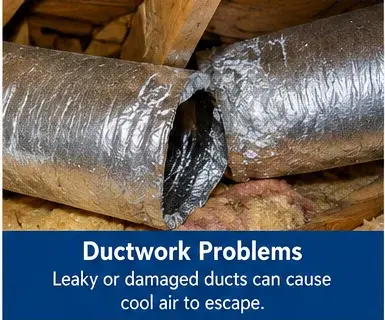
6. Your Home Has Airflow Problems
Sometimes the air conditioner itself is working properly, but the conditioned air is not getting where it needs to go.
Problems with ductwork can reduce the amount of cooled air reaching rooms throughout your home.
Potential ductwork problems include:
Leaking ducts
Disconnected ducts
Damaged ducts
Poorly insulated ducts
Restricted ducts
Improperly sized ductwork
If certain rooms are consistently warmer than others while the AC runs continuously, airflow or ductwork could be part of the problem.
7. Your Home May Have Air Leaks or Poor Insulation
Your HVAC system is not the only factor affecting indoor temperature.
If cooled air is escaping through gaps around doors, windows, ductwork, or other areas, your air conditioner has to work harder to maintain the desired temperature.
Poor insulation can have a similar effect.
This can be especially noticeable during the hot, humid North Carolina summer when your home is exposed to high outdoor temperatures for extended periods.
Improving insulation and sealing significant air leaks can sometimes reduce the workload placed on your HVAC system.

8. Your AC May Be Too Small for Your Home
An improperly sized air conditioner may struggle to keep up with the cooling demands of the home.
If an AC system is too small, it may run for long periods while still failing to maintain the desired indoor temperature.
However, bigger is not always better.
An oversized air conditioner can also create problems because it may cool the home too quickly without running long enough to properly remove humidity.
Proper HVAC sizing takes into account factors such as the home's size, insulation, windows, orientation, ductwork, and other characteristics.
If you have persistent cooling problems, an HVAC professional can determine whether system sizing is contributing to the problem.

9. Your Air Conditioner Is Getting Old
Air conditioners generally become less efficient as they age.
Older equipment may require more frequent repairs and may not cool as efficiently as a newer system.
If your AC runs constantly, your energy bills are increasing, and the system requires frequent repairs, it may be worth comparing the cost of continued repairs with the cost of replacement.
That does not necessarily mean an older system needs to be replaced immediately. A professional inspection can help determine the condition of the equipment and the options available.

10. It's Simply Very Hot Outside
Sometimes there isn't anything wrong with the air conditioner.
During extremely hot weather, particularly when outdoor temperatures remain high for much of the day, your AC may run for long periods simply because it has a large amount of heat to remove.
This can be especially true if you keep your thermostat at a relatively low temperature.
For example, asking an air conditioner to maintain a very low indoor temperature while outdoor temperatures are extremely high can result in extended run times.
The important question is whether the system is keeping your home reasonably comfortable.
If the AC runs frequently but maintains the thermostat setting and the home feels comfortable, extended operation during extreme heat may be normal.

Why Is My AC Running Constantly but Not Cooling?
If your air conditioner is running continuously but the temperature inside your home continues to rise, that is more concerning.
Several problems can cause this situation, including:
Dirty air filters
Low refrigerant
Refrigerant leaks
Frozen evaporator coils
Dirty condenser coils
Compressor problems
Electrical problems
Airflow restrictions
Ductwork problems
Thermostat issues
An aging or improperly sized system
If your AC is running constantly and your home is not cooling properly, professional AC troubleshooting can help identify the actual cause.
Will Running My AC Constantly Increase My Electric Bill?
It can.
The longer your air conditioner operates, the more electricity it may consume. If the system is running continuously because of an underlying problem, your energy costs may increase without providing the expected level of comfort.
A sudden increase in your electric bill combined with longer AC run times is worth investigating.
However, electricity usage can also increase because of weather conditions, thermostat settings, changes in household usage, and other factors.
What Should I Check Before Calling an HVAC Technician?
Before scheduling service, there are a few basic things you can safely check.
Check the thermostat
Make sure the thermostat is set to Cool and that the temperature setting is appropriate.
Check the air filter
If the filter is visibly dirty or clogged, replace it with the correct size and type.
Check the outdoor unit
Make sure leaves, grass, weeds, and other debris are not blocking the outdoor unit.
Check the air coming from your vents
If the system is running, check whether the supply vents are producing cool air and whether airflow seems normal.
Look for ice
If you see ice on the refrigerant lines or indoor coil area, turn the AC off and allow it to thaw. Continued operation while the system is frozen can potentially make the problem worse.
If these basic checks don't solve the problem, it's time to have the system professionally diagnosed.

When Should I Call for AC Repair?
You should consider professional AC repair when your system runs constantly and:
The home won't reach the thermostat setting
The air coming from the vents isn't cold
The system is freezing
You notice water around the indoor unit
Your energy bill suddenly increases
The outdoor unit isn't operating correctly
The system makes unusual noises
The AC repeatedly shuts off and restarts
The system requires frequent repairs
For more information about common cooling problems, see our related articles:
[Why Is My AC Running But Not Cooling?]
[Why Is My AC Freezing?]
[Why Is My AC Leaking Water?]
[Why Is My AC Making Noise?]
These articles can help homeowners understand some of the most common AC symptoms before deciding what to do next.

Professional AC Repair in Wake Forest and Surrounding Areas
A constantly running air conditioner does not automatically mean you need a new HVAC system. The cause could be something as simple as a dirty filter or something more involved, such as a refrigerant problem, airflow issue, or failing component.
At Holm Heating and Cooling, we provide AC repair and HVAC services for homeowners throughout Wake Forest and surrounding communities.
If your air conditioner is running constantly, struggling to cool your home, or showing other signs of trouble, our team can inspect the system, identify the cause, and explain your repair options.
We proudly serve Wake Forest, Raleigh, Rolesville, Youngsville, Franklinton, Louisburg, Zebulon, Wendell, Knightdale, and surrounding areas.
When your air conditioner isn't keeping up, don't ignore the problem. Getting the system checked can help restore comfort and prevent a small issue from developing into a more expensive repair.


Comments